
9.7 KiB
Ubuntu 20.04LTS installation into the LVM on the LUKS volume.
This is a script corrections to help the installation of Ubuntu with the full disc encryption. These scripts are designed to achieve followings :
- Using Ubiquity installer, for the ease of install.
- Automatic detection of BIOS/EFI firmware and create MBR/GPT, respectively.
- Install Ubuntu to the LVM/LUKS volume.
- The /boot is located in the same volume with the "/". Thus, /boot is also encrypted.
- The swap volume is located inside encrypted volume.
- Support multi-boot installation. You can reserve certain encrypted volume space for the other distribution.
By the configuration parameters, you can apply these scripts to relatively wide variation of the system. For example, you can configure the system to accept 2, 3 or 4 distributions in a HDD/SSD, as you want.
Following is the HDD/SSD partitioning plan of these scripts ( In case of BIOS, the disk has MBR and doesn't have EFI partition).
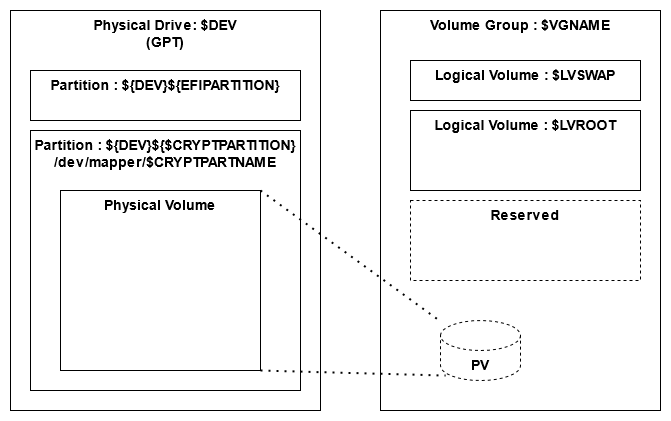
The logical volume size of each Linux distribution ($LVROOT) can be controlled from a configuration parameter.
As depicted the LVM volume group has only one physical volume.
Test environment
These scripts are tested with following environment.
- VMWare Workstation 15.5.7 ( EFI/BIOS )
- Ubuntu 20.04.2 amd64 desktop
- Ubuntu Mate 20.04.2 amd64 desktop
Preparation
This script is designed to use by copy-and-past to the shell (bash) window. So, it is strongly recommended to prepare the net work connection, and show this page and the shell window side-by-side If it is impossible, you may want to copy these scripts into a USB memory and jack into your machine, during the installation, to allow the copy-and-paste.
Installation
Follow the steps below.
Preparation of shell window
First of all, promote the shell to root. Almost of the procedure requires root privilege.
# Promote to the root user
sudo -i
Input Passphrase
Input a passphrase to lock your crypt system. This passphrase is required to type when GRUB starts. The passphrase is recorded as an environment variable to refuge the type multiple time without error.
# Setup the passphrase of the crypt partition
read -sr PASSPHRASE
Configuration parameters
This is very critical part of the installation. Following is a set of parameter for the configuration of :
- Install to /dev/sda.
- In case of EFI firmware, 100MB is allocated to the EFI partition.
- Rest of the disk space is assigned to the LUKS volume.
- Create and logical volume group named "vg1" in the encrypted volume.
- Create a swap logical volume named "swap" in the "vg1". The size is 8GB.
- Create a logical volume named "ubuntu" for / in the "vg1". The size of the 50% of the entire free space.
If you don't like above configuration, you can modify the following parameter before pasting to the shell window. Note : EFI/BIOS detection is done automatically.
# Device to install the linux.
export DEV="/dev/sda"

# Logical Volume name for your Linux installation. Keep it unique from other distribution.
export LVROOT="ubuntu"

# Logical volume size of the Linux installation.
# 50% mean, new logical volume will use 50% of the free space in the LVM volume group.
export ROOTSIZE="50%FREE"

# Configure to make swap or not. 1 : Make, 0 : Do not make.
# Set 0 if you add a distribution to the system, to avoid to make swap twice (it causes error).
export MAKESWAP=1


# Usually, these names can be left untouched unless existing resources use.
export CRYPTPARTNAME="luks_volume"
export VGNAME="vg1"
export LVSWAP="swap"

# Set the size up to your favorite. The unit is Byte. you can use M,G... notation.
export EFISIZE="100M"
export SWAPSIZE="8G"

# DO NOT touch following lines.

# export to share with entire script
export PASSPHRASE

# Detect firmware type. 1 : EFI, 0 : BIOS
if [ -d /sys/firmware/efi ]; then
export ISEFI=1
else
export ISEFI=0
fi

# Set partition number based on the firmware type
if [  ${ISEFI} -eq 1  ] ; then
export EFIPARTITION=1
export CRYPTPARTITION=2
else
export CRYPTPARTITION=1
fi
Format the disk and encrypt the LUKS partition
C A U T I O N : Following script destroys all the data in your disk. Make sure you want to destroy all.
If you want to add a new distribution to the existing distribution, following script block must be skipped. The GPT for EFI, MBR for BIOS is created.
# Optional : Create partitions for in the physical disk.
# Assign specified space and rest of disk to the EFI and LUKS partition, respectively.
if [  ${ISEFI} -eq 1 ] ; then
# Zap existing partition table and create new GPT
sgdisk --zap-all "${DEV}"
# Create EFI partition and format it
sgdisk --new=${EFIPARTITION}:0:+${EFISIZE} --change-name=${EFIPARTITION}:"EFI System"  --typecode=${EFIPARTITION}:ef00 "${DEV}"
mkfs.vfat -F 32 -n EFI-SP "${DEV}${EFIPARTITION}"
# Create Linux partition
sgdisk --new=${CRYPTPARTITION}:0:0    --change-name=${CRYPTPARTITION}:"Linux LUKS" --typecode=${CRYPTPARTITION}:8309 "${DEV}"
# Then print them
sgdisk --print "${DEV}"
else
# Zap existing Mpartition table
dd if=/dev/zero of=${DEV} bs=512 count=1
# Create MBR and allocate max storage for Linux partition
sfdisk ${DEV} <<EOF
2M,,L
EOF
fi

# Encrypt the partition to install Linux
printf %s "${PASSPHRASE}" | cryptsetup luksFormat --type=luks1 --key-file - --batch-mode "${DEV}${CRYPTPARTITION}"
Open the LUKS partition
You have to opened the LUKS partition here for the subsequent tasks.
# Open the created crypt partition. To be sure, input the passphrase manually
printf %s "${PASSPHRASE}" | cryptsetup open -d - "${DEV}${CRYPTPARTITION}" ${CRYPTPARTNAME}

# Check whether successful open. If mapped, it is successful.
ls -l /dev/mapper
Configure the LVM in LUKS volume
The swap volume and / volume is created here, based on the given parameters.
# Create the Physical Volume and Volume Group.
pvcreate /dev/mapper/${CRYPTPARTNAME}
vgcreate ${VGNAME} /dev/mapper/${CRYPTPARTNAME}

# Create a SWAP Logical Volume on VG,
if [ ${MAKESWAP} -eq 1 ] ; then lvcreate -L ${SWAPSIZE} -n ${LVSWAP} ${VGNAME} ; fi

# Create the ROOT Logical Volume on VG.
lvcreate -l ${ROOTSIZE} -n ${LVROOT} ${VGNAME}
Run the Ubiquity installer
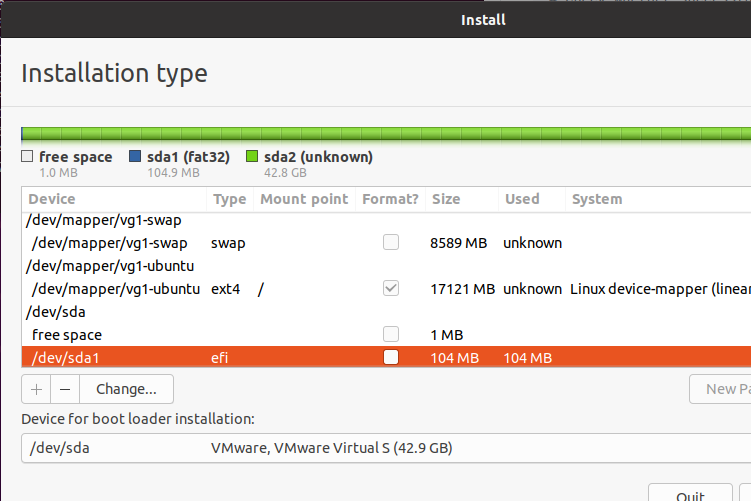
Open the Ubiquity installer, configure and run it. Ensure you map the followings correctly ( The host volume name in this example is based on the default values of the configuration parameters. Map the right volumes based on your configuration parameters). In case of BIOS, do not map the /dev/sda for /boot/efi.
| Host Volume | Target Directory |
|---|---|
| /dev/sda1 | /boot/efi |
| /dev/mapper/vg1-ubuntu | / |
| /dev/mapper/swap | swap |
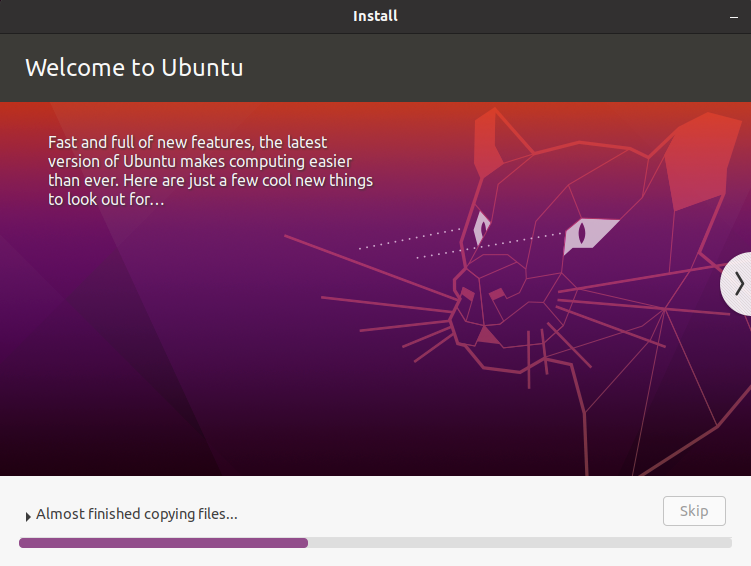
C A U T I O N : If the installer start the file copying, execute next script quickly before the installation finishes.
Configure the target GRUB during the Ubiquity runs
Run the following script on the shell window, during the Ubiquity runs. Otherwise, Ubiquity fails at the end of installation.
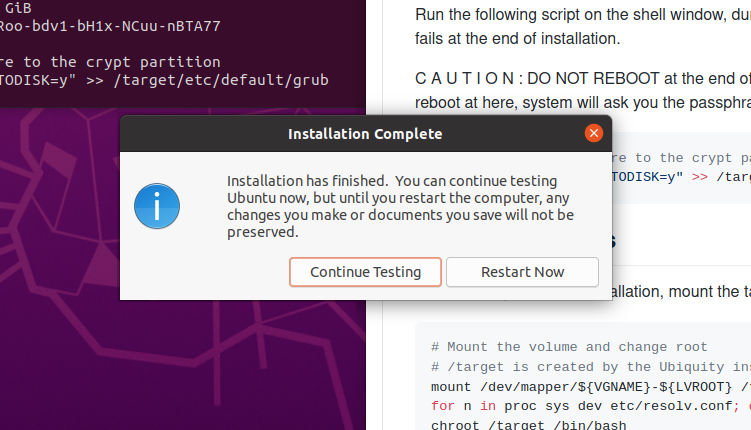
C A U T I O N : Do not reboot at the end of Ubiquity installation. Click "continue".
# Make target GRUB aware to the crypt partition
echo "GRUB_ENABLE_CRYPTODISK=y" >> /target/etc/default/grub
Click continue
As noted above, do not reboot. Click "Continue Testing". If you reboot at here, system will ask you the passphrase twice.
Mount the target file system
After Ubiquity finish the installation, mount the target directories and chroot to that.
# /target is created by the Ubiquity installer
mount /dev/mapper/${VGNAME}-${LVROOT} /target

# And mount other directories
for n in proc sys dev etc/resolv.conf; do mount --rbind "/$n" "/target/$n"; done

# Change root
chroot /target /bin/bash
Add auto decryption to the target kernel
Now, we are at critical phase. To avoid system asks passphrase twice, we have to embed the encryption key inside ramfs initial image. This image with key is stored in the LUKS volume, so, it is in the safe storage. GRUB decrypt this LUKS volume, upload the ramfs image to the RAM, and pass it to the booted Linux kernel as memory pointer.
As a result, GRUB can pass the encryption key to Linux kernel as safe way.
# Mount the rest of partitions by target /etc/fstab
mount -a

# Set up the kernel hook of encryption
apt install -y cryptsetup-initramfs
echo "KEYFILE_PATTERN=/etc/luks/*.keyfile" >> /etc/cryptsetup-initramfs/conf-hook
echo "UMASK=0077" >> /etc/initramfs-tools/initramfs.conf

# Prepare a key file to embed in to the ramfs.
mkdir /etc/luks
dd if=/dev/urandom of=/etc/luks/boot_os.keyfile bs=4096 count=1
chmod u=rx,go-rwx /etc/luks
chmod u=r,go-rwx /etc/luks/boot_os.keyfile

# Add a key to the key file. Use the passphrase in the environment variable.
printf %s "${PASSPHRASE}" | cryptsetup luksAddKey -d - "${DEV}${CRYPTPARTITION}" /etc/luks/boot_os.keyfile

# Add the LUKS volume information to /etc/crypttab to decrypt by kernel.
echo "${CRYPTPARTNAME} UUID=$(blkid -s UUID -o value ${DEV}${CRYPTPARTITION}) /etc/luks/boot_os.keyfile luks,discard" >> /etc/crypttab

# Finally, update the ramfs initial image with the key file.
update-initramfs -uk all
Finishing installation
Done!!
You can reboot. Linux and GRUB are installed in a encrypted storage. The system will ask you the passphrase only once when GRUB starts.
exit
reboot
Acknowledgments
These scripts are based on the script shared on the myn's diary. That page contains rich information, hint and techniques around the encrypted volume and Ubiquity installer.